Railway station

Marijampole Railway Station was built between 1923 and 1924 and has a great architectural value. It is one of the most decorated objects of such functional style in Lithuania. In terms of composition and style, the station is original among the buildings of this purpose in Lithuania. The station is bunk, with a large local water tower in the center and a single-storey trunk and administrative premises. The building is made of brick, the exterior walls are covered with red finishing tiles with inserts of plastered parts. Asymmetrical, progressively developing composition of the building is characteristic of the modern direction. In the décor of the building there are also supports of historical styles (attic decoration elements close to neobarok, high chimneys are taken from neo-Gothic), but thanks to stylization, this detail harmoniously binds to the whole. Valuable and protected elements and parts of the building are the volume of the building, authentic materiality, facades and their décor, interiors and their décor, planned – spatial structure, authentic joinery products (passenger waiting room benches, doors, windows).

Comments Off on Railway station
Read more about the article Monument to Vincas Mykolaitis-Putinas
OLYMPUS DIGITAL CAMERA

Monument to Vincas Mykolaitis-Putinas

Vincas Mykolaitis-Putinas was a Lithuanian poet and prose writer, literary historian, philosopher and translator. Best known for his symbolist poems and novel “Altorių šešėly". The novel, which appeared in 1933, gained enormous popularity. “Altorių šešėly" is the first work in Lithuanian literature, which shows the beginning of the 20th century, the life of priests and the experiences of a young priest. In 1993, a monument to the classic of Lithuanian literature Vincas Mykolaitis-Putinas was unveiled. Sculptor Alfonsas Ambraziūnas, "...metal perpetuates the world of the writer's spirit and the legacy of creation". The project was prepared by architect Valentinas Medelis.

Comments Off on Monument to Vincas Mykolaitis-Putinas

Monument to the Duke of LDK Vytenis

Sculptor Gabrielius Stanulis created a monument to Duke Vytenis in a military town in 1938. In the 1940s, when the Soviet occupation began, a division of Soviet paratroopers settled in the battalion, the monument was demolished and destroyed. The historical and cultural heritage of the General Support Logistics Battalion of the Grand Duke of Lithuania Vytenis was taken care of after 1993, when the Soviet army was withdrawn from Lithuania. The monument was restored in March 2009 by sculptor Julius Narušis in the same place – pond island.

Comments Off on Monument to the Duke of LDK Vytenis

Monument to Kristijonas Donelaitis (1714-1780)

Kristijonas Donelaitis was an evangelical Lutheran priest and pioneer of Lithuanian fiction. To commemorate the 300th anniversary of the poet's birth, UNESCO added this anniversary to the list of 100 dates important to world culture, education, science and historical memory, and the poem “Metai" was recognized as a masterpiece of European literary heritage. The monument to K. Donelaitis at the Evangelical Lutheran Church was unveiled in 2013 to commemorate the 300th anniversary of the literary classic.

Comments Off on Monument to Kristijonas Donelaitis (1714-1780)

Monument to linguist Jonas Jablonskis

The gymnasium yard has a sculpture for Jonas Jablonskis. It is the same man who had a huge influence on this this school, that is the reason why the school was named after him. The sculpture was opened in 1992, the author of this work is – Petras Aleksnadravicius. Rygiskiu Jonas – one of the most popular nicknames, which reflects his native village Rygiskės, in the district of Šakiai.

Comments Off on Monument to linguist Jonas Jablonskis

Monument to Vytautas the Great

In 2003, the Vytautai club of Marijampolė proposed an idea to build a monument for Vytautas the Great and began collecting funds to implement the idea. On 22 May 2010 the idea was realised – a monument for Vytautas the Great created by sculptor Julius Narušis was introduced in the reconstructed park. A granite monument of 9 metres in height comprise a pedestal and Grand Duke Vytautas riding a horse.

Comments Off on Monument to Vytautas the Great

The Tribute to the Nation and Language monument

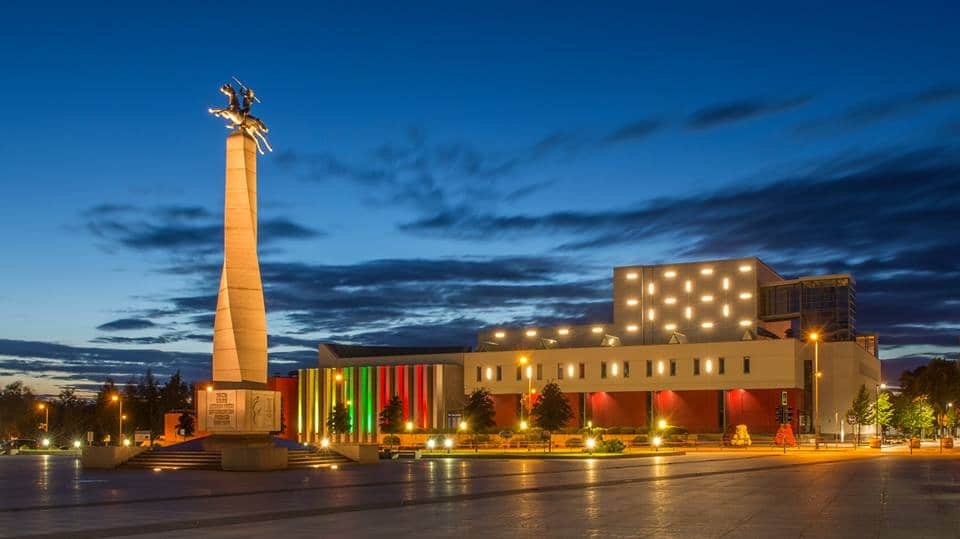
On 6 September 2009 at J. Basanavičius square a monument called Tribute to the Nation and Language was unveiled to commemorate the millennium of the name of Lithuania (1009– 2009). In the Interwar period an idea emerged to build a statue of Freedom in the central square of Marijampolė, but the idea failed to materialise. However, it was remembered as the millennium anniversary of the name of Lithuania drew closer. Sculptor Kęstutis Balčiūnas created a monument of pink granite and stainless steel, almost 20 metres in height and weighing 300 tonnes. The rectangle foundation of the monument is decorated with bas-reliefs: the first one is an inscription of the words ‘For the nation, for the language, for commemoration of the millennium of the name of Lithuania 1009–2009’; the second depicts a Krivis (priest) standing at an altar, an oak tree and a stone with runes; the third one is dedicated to Martynas Mažvydas and the first Lithuanian book; the fourth one shows father of our language Jonas Jablonskis and the words from the Postilla of Mikalojus Daukša. The four corners of the base symbolise the four regions of Lithuania. A rising spiral column signifies the hard road to the survival of the Lithuanian nation. At the top of the column is a shining silver rider on a horse. The horse is a symbol of the nation’s drive and its unstoppable movement forward. The rider is a free nation and the spear he is holding is a symbol of the nation’s word and endurance.

Comments Off on The Tribute to the Nation and Language monument

A bench of Violeta Urmanavičiūtė-Urmana

Also known as the Nightingale bench. On 8 September 2012, after the concert of world-famous singer Violeta Urmanavičiūtė-Urmana, her hometown unveiled a bench named after her. Sculptor Kęstutis Lanauskas. Violeta Urmanavičiūtė was born in 1961. She studied in the 2nd High School (currently Marijampolė R. Stankevičius Primary School). Later she attended piano classes of Professor Vlada Mikštaitė in Vilnius Conservatoire, then continued her education in a solo singing class. In 1991–1993 she studied in the Astrid Varnay master class of the Munich Higher School of Music, at the same time attending the Opera Study under the National Opera of Munich. As of 1993, she began her career as an opera soloist in Germany, Switzerland, France. She won several international awards, was invited for a debut in the Bayreuth Festival. The soloist sang on the stages of the best-known theatres in the world – in New York, Milan, Munich and elsewhere. Urmanavičiūtė sang under the direction of the most famous conductors of Lithuania and the world. Violeta Urmanavičiūtė-Urmana was awarded the Lithuanian National Prise for Culture and Arts. The singer was named a honorary citizen of the city of Marijampolė.

Comments Off on A bench of Violeta Urmanavičiūtė-Urmana