Culture engine BWM
Information will be available soon.
This temple is associated with the miracle of Augustavas or the miracle of God‘s mother. When the first world war broke out after the first victories, the Dizzying Russian army from East Prussia was pushed back by the Germans and the Tsarist army fell into the woods of Augustavas. On September 1, 1914 (according to the old calendar), at about 11 o'clock in the evening, soldiers of the Kirasyr squad, upon hearing the movement of enemies nearby, kneeled on their knees and began to pray. Some time later, the gulls saw a bright star in the sky, which turned into a swarm of small stars from which the Mother of God appeared with the baby on her hands. She showed the direction west by hand. This view remained in the sky for half an hour, then the remote warriors successfully retreated from the surroundings. This miracle was also seen by the nearby Don Cossack Squad. After September, the first German attack on the entire front suppressed... The Holy Synod of Russia, having studied this event in 1916, recognized it as a miracle.
It is the oldest brick building in Marijampolė. The old Marijampolė Hospital was built when Užnemunė and our city went to Prussia. The hospital had 30 beds for patients. President Kazys Grinius wrote in his memoirs the following story of the appearance of this hospital, "The Queen of The Prussians who visited Marijampolė, a very good woman, she met two impoverished, frozen children in the city who asked for begging. - Why don't you go to school, why don't you treat scabs? " the Queen asked. The children replied that neither the school nor the doctor were there. The Queen then ordered to establish both a school and hospital in the city." The good woman whom the prussians considered a saint was Queen Luiza, the wife of King Frydrichas Vilhelmas III of Prussia, who ruled from 1797 to 1840.
In 1739, counts Markas Antonijus ir Pranciška Butleriai founded the city of Starapolė on the site of the former village of Stara Būda. In 1750, he invited the marion monks to settle near the town and built a wooden church and monastery for them. The new city was named Marijampolė – the city of Marion. People tell a beautiful legend of how Countess Pranciška chose a place for the church. She walked out of the Kvietiškis manor and was praying as she was walking. The Countess finished her pray and she said at the end, "There will be a church here." A church was built on that site.
The house on the corner of P. Butlerienė and Laisvės streets was built in interwar Lithuania. A merchant of beer and other alcoholic beverages settled there. Advertisements adorning the façade of the building – bottles, according to the locals, determined the fate of this house. After the second world war, a "šnapsinė" settled here, and the grandma who lived in the house traded in a homemade one. This advertisement is the only one that has survived in Marijampolė since the beginning of the 20th century.
A beautiful legend is told that while celebrating Purim (Spring Festival), the Jewish community of Marijampolė collected food for the poor. Everyone contributed as much as they could, only one rich Jew refused to donate to the needy. Then the committee for collecting donations, after consulting the rabbi, decided to place a pint of donated food at the door of the rich man during the Feast of Purim and not take it until the rich man in question had donated a large amount of money to the poor. Since then, this citizen of Marijampolė never forgot the poorer townspeople.
According to the legend, Countess Francis Ščiukaitė-Butlerienė, the founder of Marijampolė city, loved and cared for cats very much. It is possible that this is not only a beautiful legend, since the patron saint Francis Romietė was the patron saint of the Countess, and as you know, the Eternal City is famous not only for its excellent buildings and its impressive history, but also for the abundance of cats. During the redevelopment of the old town of the city, the cats of Countess Francis Ščiukaitė-Butlerienė playing with water appeared there. The patio quickly became everyone's favorite place, and the locals noticed that when you come up with a desire and pat all three cats, it really comes true. However, cats of Suvalkija character do not fill the financial wishes... Although the try is definitely worth it. If you sit in the cat's backyard with a cup of coffee, you might get and see live old town cats who come here hoping to be given a delicious treat.
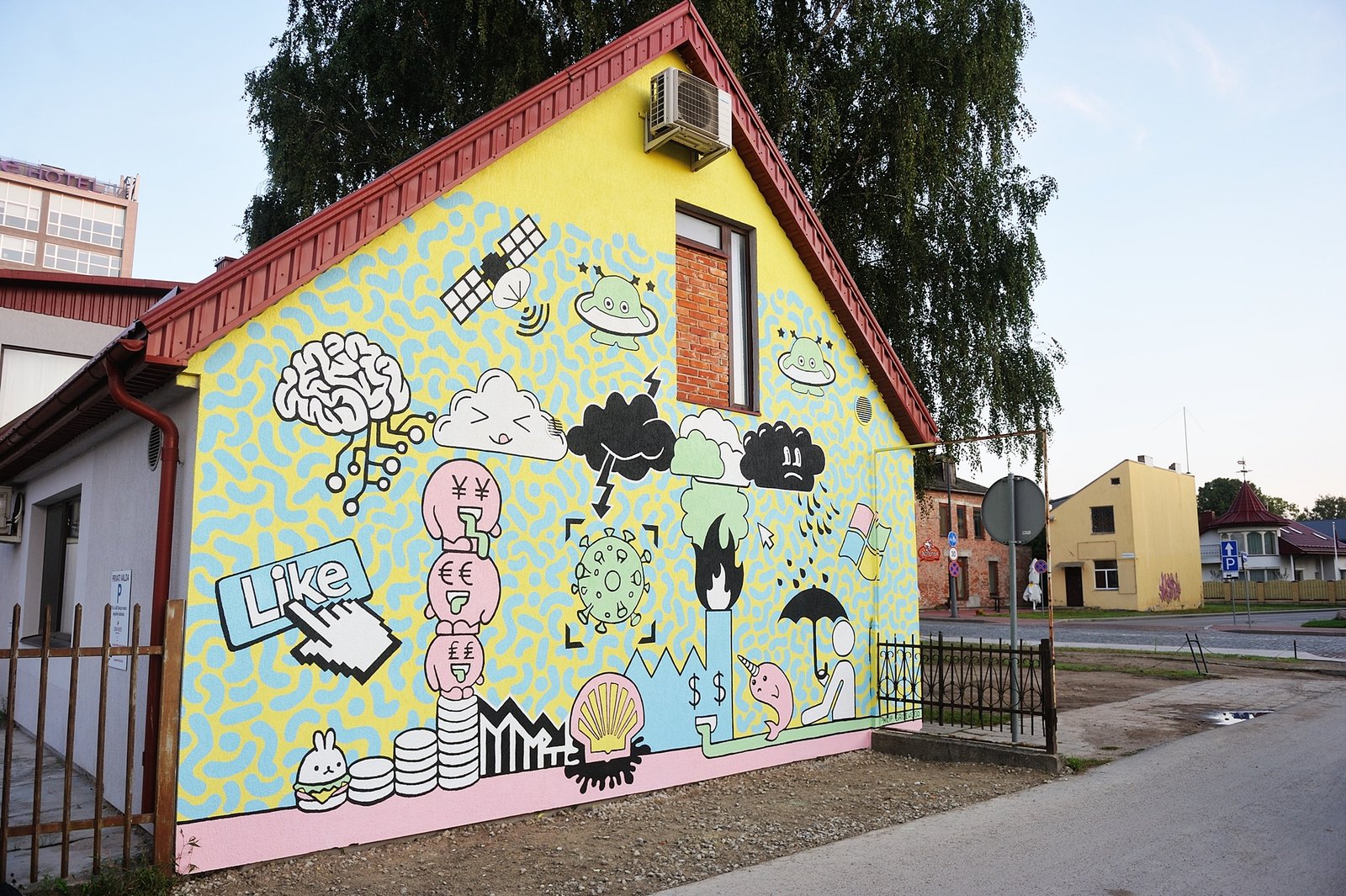
The postal tract began to be built in 1828 , the third year of Tsar Nicholas I's rule. It was completed in 1836. At that time, it was a modern path, important for economic development and political activity. For the affairs of the tract, postal stations, houses of station supervisors, road firewalls, bitter ones were built. In Jonas Basanavičius Square, this historic road is marked by chandeliers installed in the square's way. Artist Ray Bartkus, founder of the Art Symposium Malonny painted a piece in which Canadian poet, singer and songwriter Leonard Cohen is waiting for a bus to Vilkaviškis. Bob Dylan and Leonardo are depicted on the wall. Cohen's roots are in Suvalkija region, so this work is a link to the land of their ancestors.
Jonas Jablonskis introduced many new things in our language, without which we cannot do today. Now we probably would not have words such as future, past, compatriot, peasant, scientist, fellow, board, court, imagination, influence, impression, progress, oxygen, etc. However, Jonas Jablonskis ruthlessly chased newcomers who were misguided from the writings, such as the future (future), the art (content), science (school), the handball (textbook), the writer (writer), the image (imagination) and others. And how did the word pupil appear thanks to the father of the Lithuanian literary language? A well-known story of how, while still a student, Jonas Jablonskis returned to his homeland for a vacation and saw a peasant in the field, and a young bull going by the side. When asked why the young man was "lazy", the peasant replied that he was still a schoolboy and was learning to work by going next to an older one. In this way, the "školnikas" and other non-Lithuanian names of children in education were changed by the pupil and remained to this day.